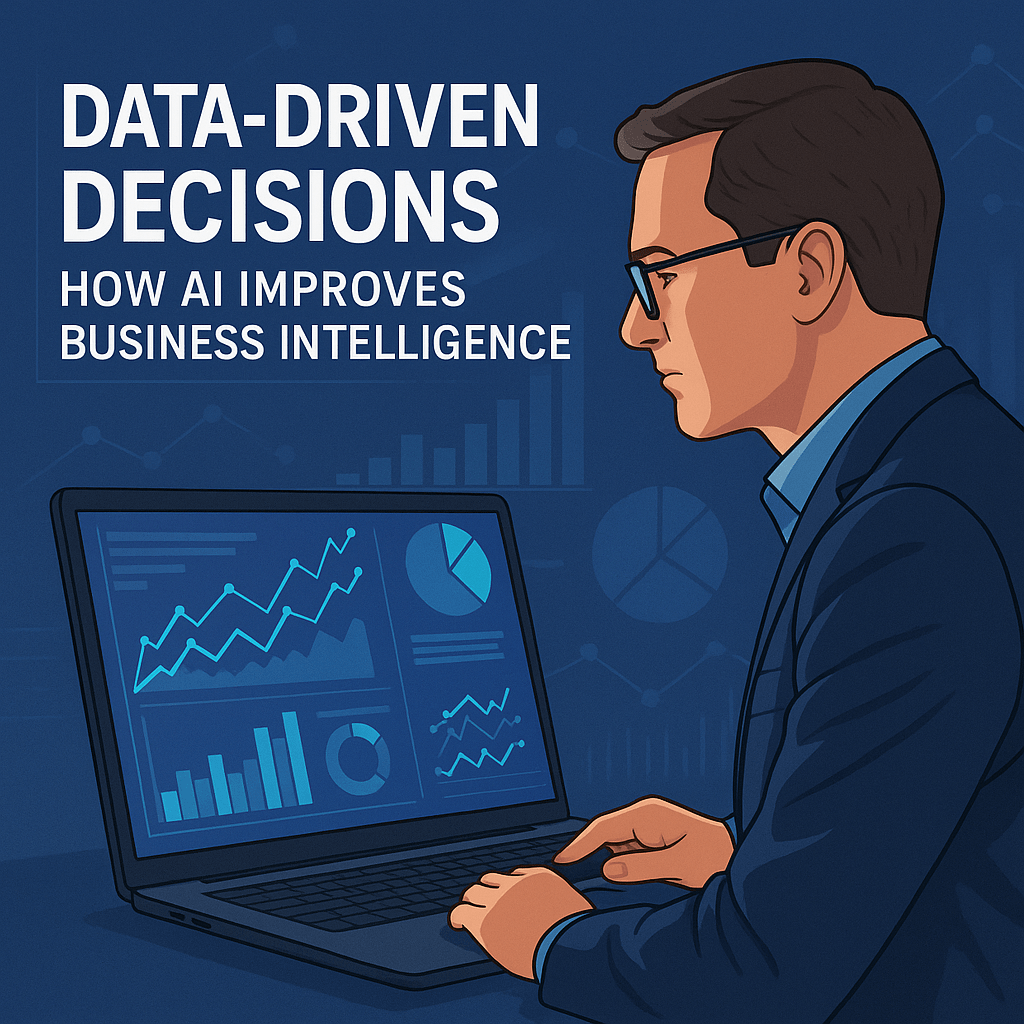

Introduction
In today’s digital world, data isn’t just an asset — it’s the lifeblood of business growth. But raw data alone isn’t enough.
Every day, businesses generate massive volumes of information — from sales transactions and marketing campaigns to customer feedback and inventory levels.
Yet, most small and mid-sized businesses struggle to translate this data into actionable insights. That’s where Artificial Intelligence (AI) steps in.
AI doesn’t just analyze data faster — it understands patterns, predicts outcomes, and even recommends decisions. It’s turning Business Intelligence (BI) from a static reporting tool into a dynamic decision-making system.
In this article, we’ll explore how AI-powered BI transforms data into strategy — helping businesses make smarter, faster, and more profitable decisions.
1️⃣ What Is Business Intelligence (BI)?
Business Intelligence (BI) refers to the processes, tools, and technologies used to collect, analyze, and visualize data so leaders can make informed decisions.
Traditionally, BI relied on spreadsheets and manual reports. But modern BI combines automation, AI, and real-time analytics to deliver insights in seconds.
Traditional BI vs. AI-Powered BI
| Feature | Traditional BI | AI-Powered BI |
|---|---|---|
| Data Processing | Manual or rule-based | Automated and self-learning |
| Speed | Hours or days | Real-time |
| Predictions | Historical only | Predictive & prescriptive |
| Human Involvement | High | Minimal intervention |
| Decision-Making | Descriptive | Proactive & intelligent |
💡 Pro Tip:
Think of AI as the “brain” added to BI — turning dashboards into decision-makers.
2️⃣ How AI Enhances Business Intelligence
AI takes BI beyond human limits — spotting trends, anomalies, and opportunities that humans might miss.
A. Predictive Analytics
AI forecasts future outcomes using machine learning models.
Example: predicting sales next quarter or identifying which products will trend.
B. Automated Insights
AI tools scan millions of data points to generate clear summaries like:
“Revenue is up 15% due to a surge in Product A sales in the Midwest.”
C. Natural Language Queries
Modern BI tools like Power BI and ThoughtSpot let users ask, “Which region performed best last month?” — and AI instantly generates the answer.
D. Real-Time Decision Support
AI dashboards update live, so executives always act on the latest numbers — not yesterday’s reports.
E. Prescriptive Recommendations
Instead of just showing data, AI suggests what to do next:
“Reduce prices in Region B by 5% to regain market share.”
💡 Pro Tip:
AI isn’t just descriptive — it’s directive. It tells you what’s happening, why it’s happening, and what to do about it.
3️⃣ Real-World Applications of AI in Business Intelligence
Let’s look at how different industries are applying AI-enhanced BI today.
1. Retail & E-commerce
- Predicting inventory demand and reorder cycles.
- Personalizing recommendations to boost cross-selling.
- Analyzing abandoned carts to refine promotions.
🛍 Example:
A Shopify-based fashion retailer used AI-driven dashboards to adjust ad budgets in real time. Result? 22% higher ROI and reduced stockouts.
2. Finance
- Detecting fraud and unusual spending behavior.
- Automating risk assessments.
- Forecasting market volatility.
💰 Example:
A fintech startup used AI BI to identify micro-loan defaulters early, cutting losses by 18%.
3. Healthcare
- Predicting patient readmissions.
- Optimizing resource allocation.
- Monitoring diagnostics in real-time.
🏥 Example:
A hospital network used AI BI to predict ER traffic during seasonal spikes, reducing patient wait times by 30%.
4. Marketing
- Segmenting audiences by behavior, not just demographics.
- Analyzing campaign performance across platforms.
- Predicting churn before it happens.
💡 Example:
A small digital agency used AI-powered Google Looker Studio to track engagement trends — increasing client retention by 25%.
4️⃣ The Core Benefits of AI in Business Intelligence
1. Faster Decisions
AI reduces analysis time from days to minutes. You act on insights when they matter most.
2. Smarter Forecasting
Machine learning models continuously refine themselves — producing increasingly accurate projections.
3. Enhanced Accuracy
AI eliminates human bias and fatigue, offering cleaner, data-backed results.
4. Democratized Analytics
Non-technical users can query data naturally — no coding required.
5. Better Resource Allocation
AI pinpoints which products, employees, or regions drive performance.
6. Continuous Learning
Unlike static dashboards, AI learns from every decision and improves future recommendations.
💡 Pro Tip:
Combine AI BI with CRM and ERP data to get a 360° business view — marketing, finance, sales, and operations all in one place.
5️⃣ Popular AI-Powered BI Tools in 2025
If you’re ready to explore AI-based Business Intelligence, here are the top tools trusted by professionals and small businesses alike:
✅ Microsoft Power BI – Real-time dashboards with natural language queries.
✅ Tableau + Einstein AI (Salesforce) – Visual analytics meets predictive intelligence.
✅ Google Looker Studio – AI-assisted dashboards and reporting.
✅ Qlik Sense – Smart data storytelling and auto-insight generation.
✅ Sisense – Embeddable AI dashboards for SaaS and apps.
✅ Zoho Analytics – Affordable and beginner-friendly.
💡 Pro Tip:
Start small — connect one key dataset (like sales or marketing) to visualize quick wins before scaling.
6️⃣ The Role of Machine Learning in Decision-Making
Machine Learning (ML) is the engine behind modern AI BI. It identifies correlations, anomalies, and growth opportunities without needing explicit programming.
Example:
A restaurant chain used ML to analyze weekly revenue across branches.
AI detected a pattern — sales dipped during bad weather.
The insight helped them launch weather-based food promotions — boosting orders by 18%.
💡 Pro Tip:
ML thrives on volume. The more data you feed, the sharper your predictions get.
7️⃣ Integrating AI BI into Your Existing Systems
Many businesses already use systems like CRMs, ERPs, or accounting software. AI BI tools integrate directly into these — enhancing existing workflows without disruption.
Integration Checklist
✅ Connect data from CRM, ERP, email, and marketing platforms.
✅ Use APIs or data connectors (Zapier, Power Automate).
✅ Build unified dashboards for sales, finance, and marketing.
✅ Schedule automatic insights reports.
💡 Pro Tip:
Don’t wait for perfect data — start with what you have. AI can clean and normalize it automatically.
8️⃣ Common Challenges (and How to Overcome Them)
1. Data Quality Issues
Garbage in, garbage out. AI can’t fix inaccurate data — it amplifies errors.
Solution: Implement consistent data entry standards and use cleansing tools like OpenRefine or Talend.
2. Lack of Technical Expertise
Non-technical teams may fear AI tools.
Solution: Choose BI tools with natural language interfaces and visual builders.
3. Integration Delays
Disconnected data sources slow progress.
Solution: Prioritize cloud-based BI with prebuilt integrations.
4. Misaligned KPIs
If you don’t define success metrics, AI insights become irrelevant.
Solution: Establish clear KPIs before building dashboards.
💡 Pro Tip:
Pilot AI BI on one department (like sales). Once ROI is visible, expand across the company.
9️⃣ How Freelancers and Agencies Are Using AI BI
Platforms like Fiverr, Upwork, and Toptal have seen a surge in AI BI specialists helping small and medium businesses adopt data-driven decision-making.
Freelancers Offer Services Like:
- Power BI or Tableau dashboard creation
- Predictive sales analysis
- Data cleaning and visualization
- AI-driven reporting automation
💡 Why Fiverr Leads the Market:
Fiverr offers pre-vetted experts who can design, deploy, and train your team — often within days.
You can even find specialists who integrate AI BI directly into WooCommerce, Shopify, or WordPress sites.
🔟 The Competitive Edge of AI BI
AI-driven BI gives smaller companies the power of enterprise-level analytics at a fraction of the cost.
Key Outcomes
🚀 Better Strategy: See what’s working before your competitors do.
📈 Improved Agility: Pivot faster using predictive alerts.
🤖 Reduced Human Error: Automated data cleaning and interpretation.
💰 Increased Profitability: Data-backed decisions outperform gut feelings.
💡 Example:
A logistics startup using Power BI + Azure AI saved $15,000 per quarter by predicting delivery delays and optimizing routes.
An Overview of What This Tip Is
AI-enhanced Business Intelligence gives you a full view of your business in real time.
It moves you from asking, “What happened?” to “What’s next?”
Instead of drowning in spreadsheets, leaders can focus on strategy, performance, and outcomes — all powered by accurate, predictive insights.
A Clear Benefit
By integrating AI into BI, you:
✅ Unlock real-time insights.
✅ Improve forecast accuracy.
✅ Reduce manual reporting hours.
✅ Make smarter, data-backed decisions.
✅ Empower teams with self-service analytics.
AI BI doesn’t just report — it recommends.
Action Items
Here’s your roadmap to implement AI-driven BI successfully:
1️⃣ Audit your data sources (sales, marketing, finance).
2️⃣ Define KPIs — what decisions you want AI to assist.
3️⃣ Choose a BI platform (Power BI, Tableau, or Looker).
4️⃣ Connect your datasets and train initial models.
5️⃣ Automate reporting and schedule AI insights.
6️⃣ Create a single “source of truth” dashboard.
7️⃣ Hire or consult an AI BI expert (on Fiverr if needed).
8️⃣ Review insights monthly and act on recommendations.
💡 Bonus:
Add your AI BI results to investor reports — showing data maturity builds credibility.
The Future of AI-Powered BI (2025–2030)
AI Business Intelligence will evolve into Autonomous Decision Intelligence (ADI) — systems that make and execute low-risk business decisions automatically.
Trends Ahead
🧠 Generative BI: Systems explaining insights in natural language.
🚀 Predictive + Prescriptive Fusion: Dashboards that suggest actions and auto-execute them.
🔒 Privacy-Centric Analytics: Federated learning to ensure data safety.
📱 Mobile-First BI: On-the-go decision dashboards powered by voice AI.
🤝 Collaborative BI: Teams co-analyzing data with AI co-pilots in real time.
💡 Pro Tip:
The winners will be the businesses that combine data literacy + AI adoption — not just data collection.
Conclusion
In a world where decisions can make or break a business, AI-powered Business Intelligence provides the clarity leaders need to act decisively.
AI turns raw data into real direction — highlighting risks, forecasting opportunities, and automating repetitive analysis.
Whether you’re a startup founder, an SME manager, or a data consultant, investing in AI BI is one of the smartest moves for long-term growth.
At InnovaByte AI, we believe that data-driven businesses don’t just react — they predict, adapt, and lead.
And if you’re ready to integrate AI into your analytics stack, you can easily find top-tier BI specialists on Fiverr, where certified experts can build your dashboards, automate reporting, and train your team.
Because in today’s data economy, success doesn’t come from what you know —
it comes from what your data tells you next.