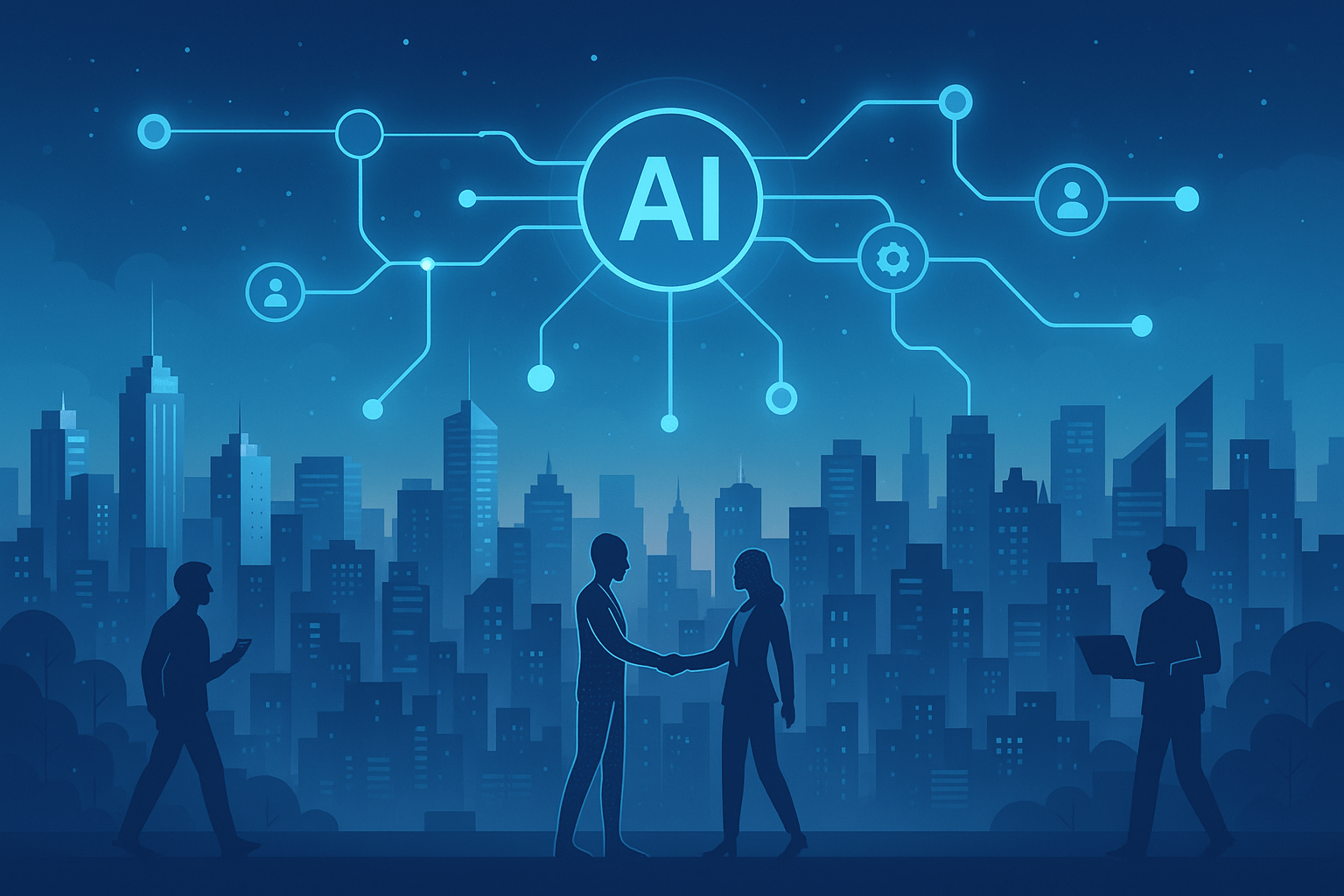

Introduction
Artificial Intelligence (AI) has evolved faster than any other technology in human history.
In less than a decade, we’ve gone from using simple recommendation engines to deploying AI systems that write code, design visuals, diagnose illnesses, and even reason strategically.
But this is only the beginning.
By 2026, AI will reach an inflection point where automation, personalization, and creativity blend seamlessly across industries.
From fully autonomous agents managing workflows to predictive business systems and AI-powered creative studios, the next few years will redefine what “work,” “creativity,” and “decision-making” even mean.
Here are five realistic but transformative predictions for AI’s evolution — and how businesses, freelancers, and entrepreneurs can stay ahead of the curve.
1️⃣ Prediction One: AI Agents Will Become the New Digital Workforce
By 2026, AI agents will function as independent digital employees capable of executing complex workflows — not just answering questions.
These systems, built on large language models (LLMs) and connected via APIs, will automate multi-step operations like scheduling, data reporting, and even customer management.
Extended Insight
Imagine a small business that hires an “AI operations agent.” This agent:
- Pulls data from Shopify and Google Analytics,
- Generates a weekly performance dashboard,
- Writes an email summary for the CEO, and
- Suggests marketing actions for the coming week.
That entire cycle, once handled by three employees, becomes fully automated.
Freelancers too will evolve — instead of handling projects solo, they’ll orchestrate teams of AI agents.
A copywriter may oversee one agent for research, another for drafting, and a third for SEO refinement.
Real-World Example
Startups like Cognosys and AutoGPT already allow users to set AI “goals” that trigger continuous reasoning loops.
By 2026, these systems will integrate seamlessly with CRMs, accounting tools, and project platforms.
💡 Pro Tip:
Learn how to chain prompts and automate multi-step workflows now. In the coming years, “AI agent operator” will be one of the most in-demand roles.
2️⃣ Prediction Two: Generative AI Will Move From Creation to Strategy
Today, Generative AI helps us create content — blogs, designs, videos, and marketing materials.
By 2026, it will move from execution to strategic decision-making.
AI won’t just generate; it will plan, test, and optimize.
These systems will analyze audience reactions, test variations in real time, and recommend new creative directions based on performance data.
Example
Picture an AI-powered marketing suite that:
1️⃣ Generates ad variations.
2️⃣ Tests them across multiple demographics.
3️⃣ Monitors engagement and ROI.
4️⃣ Automatically reallocates ad spend to the top-performing creatives.
This will transform marketing from a manual creative process into a data-driven, self-improving cycle.
Extended Insight
Generative AI will merge with predictive analytics, making it possible for businesses to forecast which campaigns or visuals will perform best before they even launch.
Freelancers and small agencies will use these same systems to deliver enterprise-level strategy with minimal overhead — leveling the competitive field between startups and global firms.
💡 Pro Tip:
Position yourself not just as a designer or writer, but as an AI-driven strategist who can use insights to guide creative direction.
3️⃣ Prediction Three: Personalized AI Will Redefine Customer Experience
In 2026, personalization will move far beyond “Hi, [First Name]”.
AI will use contextual and emotional intelligence to make every interaction feel one-to-one — adapting tone, content, and visuals in real time.
How It Works
Advanced sentiment analysis and behavioral tracking will allow AI to understand:
- What a user is likely looking for,
- How they’re feeling (based on language or facial cues), and
- What type of offer or tone will drive engagement.
Example
A user browsing a skincare brand’s website at night receives calming visuals and a “sleep-care” bundle suggestion, while a morning visitor sees a “fresh start” product lineup.
The AI tailors not just what they see — but when and how they see it.
Business Impact
- Conversion rates improve through hyper-contextual experiences.
- Brands gain loyalty by predicting needs before customers articulate them.
- Privacy-first personalization becomes a selling point.
Extended Insight
As personalization deepens, trust becomes crucial.
Businesses will need transparent data practices and clear opt-in systems.
Freelancers building AI chatbots or landing pages must ensure compliance with evolving AI transparency laws.
💡 Pro Tip:
Integrate “explainable AI” features — letting users understand how recommendations are made builds credibility and boosts engagement.
4️⃣ Prediction Four: AI-Generated Data Will Power Decision-Making
We often hear, “Data is the new oil.”
By 2026, AI will not only analyze data — it will generate it.
Synthetic Data Revolution
AI systems will create synthetic datasets that mirror real-world conditions, allowing safe and scalable training for other AI systems without breaching privacy laws.
Example
A financial startup testing fraud detection algorithms can generate millions of synthetic transactions with realistic behavior patterns — without exposing actual user data.
Healthcare institutions will simulate patient data to develop better diagnostics, while retailers will model synthetic purchase histories to forecast trends.
Extended Insight
Synthetic data will:
- Overcome data scarcity in niche industries.
- Eliminate the need for costly manual data collection.
- Create fairer, bias-balanced AI systems.
This new data economy will open roles like AI Data Designer, Synthetic Scenario Analyst, and AI Training Specialist — jobs that merge creativity with technical understanding.
💡 Pro Tip:
If you’re a freelancer or consultant, start learning tools like Mostly AI and Gretel.ai — they’ll be foundational in this emerging field.
5️⃣ Prediction Five: Human–AI Collaboration Will Redefine the Workplace
The “AI vs. human” debate will soon be irrelevant.
By 2026, workplaces will be hybrid ecosystems where humans and AI agents collaborate fluidly.
Example
A marketing manager starts her day by checking in with her AI assistant:
- The AI summarizes overnight campaign results.
- It flags anomalies and drafts optimization suggestions.
- She makes final calls, adjusts budgets, and approves creatives.
Together, they achieve what a full team once handled — with more accuracy and less burnout.
Extended Insight
This shift will introduce new job archetypes:
- AI Workflow Coordinator – manages human-AI task distribution.
- Prompt Architect – crafts and refines intelligent task prompts.
- Human Validation Specialist – reviews and interprets AI outcomes.
Companies that nurture empathy, creativity, and problem-solving alongside AI skills will become innovation leaders.
💡 Pro Tip:
Invest in soft skills — storytelling, negotiation, and emotional intelligence. Machines can process logic, but humans provide meaning.
The Economic Ripple: What These Predictions Mean for Global Industries
1. Small Business Acceleration
AI automation will give small enterprises the power of large corporations — scaling operations without heavy staffing costs.
Entrepreneurs will run lean teams, combining human leadership with AI execution.
2. Freelance Revolution 2.0
Freelancers will no longer compete on price alone; they’ll offer AI-augmented value.
Expect marketplaces like Fiverr to host categories such as:
- “AI Workflow Setup”
- “Agent-Powered Marketing Systems”
- “Synthetic Data for Product Testing”
This new hybrid freelancing era will reward adaptability and continuous learning.
3. Industry Restructuring
Entire sectors — from logistics to education — will redesign their workflows around AI insights, not human intuition alone.
Businesses that adopt early will cut costs and improve speed; laggards will lose relevance.
💡 Pro Tip:
Wherever repetitive processes exist, there’s room for AI.
Start mapping your current workflows today and mark which steps can be automated or co-assisted.
An Overview of What This Tip Is
The next wave of AI innovation won’t just enhance productivity — it will reshape the global economy.
AI agents, synthetic data, and personalized systems will create a world where decision-making, creativity, and customer engagement happen in real time.
By 2026, AI will evolve from “something we use” to “someone we work with.”
A Clear Benefit
Embracing these shifts early ensures:
✅ 10× operational efficiency through AI-agent automation.
✅ Faster decision-making using real-time synthetic data.
✅ Personalized customer experiences that drive loyalty.
✅ New income streams through AI-powered freelance services.
✅ Future-proof relevance in a rapidly transforming economy.
💡 In short:
The businesses that thrive will be those that treat AI not as a cost — but as a collaborator.
Action Items
Here’s how to prepare for this AI-driven decade:
1️⃣ Map Your Workflows: Identify repetitive tasks you can automate with AI agents.
2️⃣ Experiment with Generative Tools: Use ChatGPT, Jasper, or Canva AI for real projects.
3️⃣ Learn Prompt Engineering: Clear inputs produce high-value outputs.
4️⃣ Track Emerging Roles: Follow LinkedIn trends for AI-related job titles.
5️⃣ Develop AI Ethics Literacy: Learn to balance innovation with responsibility.
6️⃣ Build an AI Portfolio: Document every automation you set up — it’s proof of your capability.
7️⃣ Collaborate, Don’t Compete: Partner with AI experts via Fiverr or similar platforms to enhance your offers.
💡 Bonus:
Set up a “90-day AI upgrade plan” — dedicate one task per week to automating or optimizing something in your workflow.
Expert Perspective: The Human Edge in the Age of AI
AI can think fast — but humans still think deep.
Our ability to empathize, tell stories, and interpret emotion will remain our strongest advantage.
The professionals who thrive will be those who combine technical fluency with human insight.
That means learning how to communicate ideas through AI, not just use it as a tool.
💬 As one industry analyst said:
“AI won’t replace you — but someone who knows how to use AI effectively will.”
💡 Pro Tip:
The future belongs to “AI-literate leaders.” Learn how to speak the language of machines while leading with the wisdom of humans.
The Road to 2030: Beyond Automation
Between 2026 and 2030, AI’s growth will be exponential, not linear.
We’ll see innovations like:
🚀 Fully autonomous organizations that operate without direct human supervision.
🎨 AI-assisted creativity studios producing art, film, and games collaboratively.
📚 AI education ecosystems teaching adaptive, personalized curriculums.
💰 Algorithmic economies where AI negotiates, trades, and optimizes resources autonomously.
The challenge won’t be building smarter machines — it will be ensuring they amplify human potential responsibly.
Conclusion
By 2026, AI will no longer be a buzzword — it will be the infrastructure behind every successful business.
It will empower humans to focus on innovation, empathy, and leadership while machines handle the grind.
Whether you’re a freelancer, a business owner, or a corporate strategist, the next few years present two choices:
✅ Adapt early and lead, or
❌ Delay and follow.
At InnovaByte AI, we believe in merging innovation with purpose — helping brands and professionals integrate AI tools that elevate their performance, creativity, and customer experience.
And if you’re looking to implement AI workflows today, Fiverr hosts certified AI developers and automation experts ready to help you set up custom agents, dashboards, and data-driven systems.
Because the AI revolution isn’t something coming “someday.”
It’s already here — and it’s waiting for those bold enough to shape it.